

BY SAKEINA SYED
Media workers face a range of workplace issues, from physical safety to navigating mental health. In a culture that can normalize enduring unhealthy working conditions, here’s what journalists need to know about their rights
Throughout Sarah’s* 10-year career as both a staff and freelance journalist, employment rights have been an unspoken topic. “You’re told to be grateful to be here, and that there are many people vying for the same positions,” she says. (Sarah is currently a working journalist; she has asked to use a pseudonym to share her experiences candidly.) “When I was in journalism school, there were no discussions about rights, concerns about unpaid internships, concerns about working overtime or anything like that.”
Media workers also deal with physical safety and mental health issues, and often persistent stress — all in the context of a culture that can normalize and encourage putting up with deeply unhealthy working conditions.
These issues affect not just the safety and wellbeing of individual journalists, but media and democracy as a whole, which both suffer when journalists face danger at work, are denied their rights or choose to leave the profession altogether. Understanding rights and how to exercise them is a key part of limiting or preventing those harms.
Employment and labour laws are not identical across Canada. Most media workplaces are governed by provincial or territorial legislation due to the country’s federal political and governance structure, and each province and territory has its own employment standards, human rights regime, and workers’ compensation system.
Some media workplaces, particularly in broadcasting, are federally regulated under the Canada Labour Code — a distinction that derives from the division of powers and regulation set out in Canada’s constitution.
The first step in assessing your rights is determining whether your workplace is federally regulated or provincially/territorially regulated, and in which province or territory you work. That determines deadlines, where complaints are filed and what remedies may be available.
RIGHTS ON THE JOB
Media workers often face workplace safety risks that are overlooked or minimized as just part of the job, says Dave Seglins, an investigative journalist and expert on mental health in journalism.
A 2022 survey of media workers done by Seglins and Carleton University professor Matthew Pearson found staggering levels of mental health concerns.
Their Taking Care Report, produced in partnership with the Canadian Journalism Forum on Violence and Trauma, found that 53 per cent of the more than 1,200 media workers surveyed had sought medical help to deal with work stress and mental health and 56 per cent reported receiving online harassment and threats. At the same time, more than half found it difficult to take a break and more than two-thirds said that they had never refused an assignment — even though many felt they wanted or needed to.
Seglins’ interest in the subject came from his own multi-decade career as an investigative journalist, which often involved difficult stories, including a “particularly gruesome” 2010 murder trial that left him with post-traumatic stress disorder.
As he recovered, he began to reckon with the fact that the traditional constraints of the journalism industry left little room for him to advocate for his mental health. “I tried to put up my hand and say to my employer, look, I can’t cover a particular story because it’s just too heavy and I’m just overwhelmed. I was being told, ‘That’s not the way it works; you don’t get to decline an assignment.’”
Efforts to address these occupational hazards can be held up by the normalization of the idea within journalism as an industry that the profession demands “unbreakable stamina,” he says.
“We view ourselves as outsiders, and observers. We witness other people’s suffering all the time and we report on it. We do stories about tragedy and disaster and human suffering, but we don’t actually reflect on how it affects us.”
He says that this perception is also coupled with the employment barriers that deter journalists from prioritizing their wellbeing. “As a young and newer journalist, you’re constantly striving to impress. It’s incredibly competitive; jobs are hard to come by, and it’s precarious,” he says. “Being picky about assignments or raising concerns about your human vulnerability in the workplace can be a career-killer.”
Since the publication of the Taking Care Report, Seglins says he has seen some steps towards recognizing trauma and mental health risks in the workplace, including work by the Canadian Association of Journalists to develop a national peer-support network.
In the fall of 2024, Seglins held a series of industry focus groups seeking employee perspectives about psychological safety at work. A CAJ-sponsored report on these takeaways was released in November 2024, called Psychological Safety in Canada’s News Industry.
“Interestingly, it’s not that some of the top issues aren’t trauma. It’s actually lack of resources, job insecurity, workload — basic working conditions. So, I think those are important things that the industry has to address,” he says.
Student newsrooms can also suffer from many of the same issues. “The funny thing about student journalists is that no one wants to take the week off,” says Charmaine Yu, a 2024-2025 opinion editor at The Varsity who was a University of Toronto student.
She says that a lot of student journalists are “quite passionate people.” This can mean that even when her colleagues are aware of their employment rights, “sometimes we do prioritize our work over our own health — which isn’t the greatest thing.”
WORKPLACE HEALTH AND SAFETY IN THE LAW
Workers’ compensation schemes can be one avenue for media workers seeking help with injuries or illness tied to their work, including issues like mental health concerns after covering traumatic stories, or physical injuries sustained on the job, whether from carrying heavy gear, being assaulted or any of the many other safety issues media workers routinely face.
Journalists may be covered by either federal or provincial workers compensation, depending on their workplace.
“The sector is a bit unusual, insofar as that there can be either federal or provincial jurisdiction, depending on who they work for,” explains Andrew Langille, a labour and employment lawyer and professor at York University. In general, workers in radio and television — a federally regulated industry — can rely on the Federal Workers’ Compensation Service, while those at newspapers can look to their provincial workers’ compensation board.
A media worker under a provincially regulated employer in Ontario, for example, could consider filing a claim under the Workplace Safety and Insurance Board. Media workers can experience a wide variety of possible injuries and illnesses which could be covered by a workers’ compensation claim. These could include physical injuries caused by an accident, or long-term problems like repetitive strain from carrying heavy equipment or long hours standing. Claims can also cover mental health issues, including those related to being exposed to traumatic situations, or the kind of long-term mental stress which can result from a toxic and unhealthy workplace.
“The worst-case-scenario is the WSIB writes back or contacts you and says, ‘Sorry, you’re not covered.’”
The WSIB offers benefits for loss of earnings, health care benefits, and non-economic loss benefits for serious or permanent injuries — although not all media workers are covered by default.
Kathrin Furniss is a lawyer at the Injured Workers Community Legal Clinic in Ontario, which specializes in workers’ compensation. She says that the law stipulates certain industries which are covered by the WSIB, and suggests that injured workers call WSIB to check if their industry or employer is covered.
Some parts of the media industry in Ontario, like news syndicates and press clipping services, for example,are not required to sign up for WSIB coverage, although some employers may still choose to do so. Furniss also notes that people employed doing writing or media work in other industries can still be covered by the workers’ compensation scheme.
Furniss notes that even if a media worker’s employer isn’t covered by the WSIB, if they are an employee they should have access to employment insurance sickness benefits.
If a worker is covered, they can report their claim. In Ontario, this starts with filling out a “Form 6,” although forms and procedures differ by jurisdiction. Furniss says that if a media worker experiences a workplace injury but isn’t sure whether they would be covered, in general she would suggest they report the claim online anyway. “The worst-case-scenario is the WSIB writes back or contacts you and says, ‘Sorry, you’re not covered,’” she explains.
Furniss says that most claims for physical injuries in the workplace are relatively straightforward, if a worker’s industry is covered. But for issues like traumatic mental stress and chronic mental stress, she says that claims can be difficult to pursue and may be less likely to be approved.
For workers who experience a physical or mental health issue on the job and are thinking about seeking workers’ compensation, Furniss generally recommends considering these factors:
- Timeliness — Furniss recommends submitting a claim as soon as possible. In Ontario, workers can submit a claim up to six months after an accident causing a physical injury, or in the case of an illness, six months after being diagnosed. In the case of a disease caused by exposure to something at work, the six-month deadline starts from when the worker learned about the disease and its connection to work.
- Regularly seeing healthcare professionals — Furniss says that it’s important to inform medical professionals about your symptoms regularly
- Documenting your experience — “Keep a little diary for yourself of how you’re feeling and what your symptoms are, and any medical appointments or conversations you have with the WSIB or your employer about it,” she says.
- Sending an objection — Even if you receive a negative decision from the WSIB, Furniss recommends sending an “intent to object” form right away. “Even if you’re not sure you want to object or pursue an appeal on it, it’s a good practice to send in an objection form to kind of bookmark your right to appeal,” she says.
Key points about making a claim:
- Not sure if your injury or illness will be covered? It’s likely worth applying anyway; the worst that can happen is a refusal. It’s important to act quickly, if possible.
- Consult a doctor.
- As you go, take notes about your symptoms and condition, and the process.
- To file a claim, find out if your workplace falls under provincial or federal jurisdiction, then apply with the relevant workers’ compensation board.
Furniss notes that even if a media worker’s employer isn’t covered by the WSIB, if they are an employee they should have access to employment insurance sickness benefits. They can also see whether their employer has short-term or long-term disability coverage. And ultimately, if a media worker is unable to work long-term and lacks savings, they can look into their province’s disability support benefit or CPP disability.
She acknowledges the serious barriers that media workers experience to pursuing workplace injury compensation. “Worker’s compensation is a really important system that should be better and should cover everybody,” she says.
“Mandatory coverage is an issue that we have been helping the injured worker push for decades. We think that everybody and every worker should be covered. The fact that, for example, most journalists and people who work in the news industry aren’t covered is a shame,” she adds.
WORKPLACE DISCRIMINATION IN THE LAW
In a highly competitive, passionate field, workers can already feel replaceable — something that can be magnified by structural inequalities, Sarah notes.
“I think it’s definitely harder to advocate for your rights when you don’t feel like you have a solid enough position in the newsroom, if you’re not on as solid footing as other people,” she says. “It takes so much longer to ‘prove yourself,’ to the powers in your newsroom. It takes a lot longer to be seen as an authority — to be seen as good enough to be given certain chances.”
As a racialized woman, she has worried that pushing to exercise her rights might mark her as a problem employee. “It’s seen as, do you just not love journalism enough to do what you’re asked?” she says. “I really think that creates a scenario where only people who have quite a lot of family, health and wealth can survive in these types of environments.”
When a media worker experiences discrimination, they are entitled to whatever recourse is available, regardless of whether or not they are unionized, or classified as an employee or independent contractor, explains Langille, the York University labour law expert.
“I would suggest that they immediately seek out legal counsel and have legal counsel engage with the union or the employer directly,” he says. Depending on the province, workers may be able to bring a human rights complaint forward without going through their union.
Another benefit that Langille highlights is the low cost of proceeding through a tribunal, which can be done for free. However, he notes that in Ontario, there have been structural problems with the tribunal that pose a barrier.
Human rights protections are jurisdiction-specific. Each province and territory has its own human rights legislation and tribunal process, while federally regulated workplaces follow a separate federal regime.
LAYOFFS
Employment rights can feel most acutely relevant at the end of a job — which is often the case in an industry marked by layoffs and publication closures.
Yu, the Varsity editor, was left with existential questions as she read through mass layoff news in the summer of 2023 and thought about her own plans: “I remember reading those headlines and going like, whoa, what does this mean for student journalists? What does it mean to graduate into a work market that doesn’t really seem to want you?”
She recalled going to a networking event that coincided with another round of mass layoffs, and leaving dejected. “When I told them I wanted to be a journalist, a lot of them just said, don’t,” she says. Attendees who were further along in their careers suggested that she try her luck in adjacent industries like PR, marketing or copywriting. “I remember feeling incredibly disillusioned last year. I was like, ‘What am I doing here?’ I love my job as a student journalist, but what does this tangibly mean for me as a person who has to enter the workforce?” she says.
Those mass layoffs are one of many developments threatening journalism’s role in democracy, all of which add up to the ongoing “erosion of Canadian news,” Yu wrote in an op-ed for The Varsity.
EMPLOYMENT STATUTES
When facing the worst-case scenario of a termination or dismissal, what options do journalists and media workers have?
Employment standards statutes establish minimum entitlements such as minimum wage, overtime pay, vacation pay, statutory holidays, and termination pay. Which statute applies depends on whether the workplace is federally regulated or provincially/territorially regulated.
Langille says that employees should also look to their written contract of employment, if they have one. “Typically, it’s going to provide entitlements that are greater or equal to the Employment Standards Act or the Canada Labour Code, so that’s what I would look to first,” he says.
If they are unionized, media workers should also check their collective agreement to make sure that they receive what it requires in the event of a dismissal.
If a non-unionized journalist finds that the severance pay in their written employment contract or terms of employment doesn’t match relevant provincial or federal legislation, they can file an employment standards claim seeking to enforce whatever the law requires.
Those standards can include things like the minimum required notice of layoff or pay in lieu, which can vary depending on their duration of employment. Some workers might be entitled to a larger amount if they’ve worked for a certain duration at an employer of a larger size — this is outlined in the employment standards legislation.
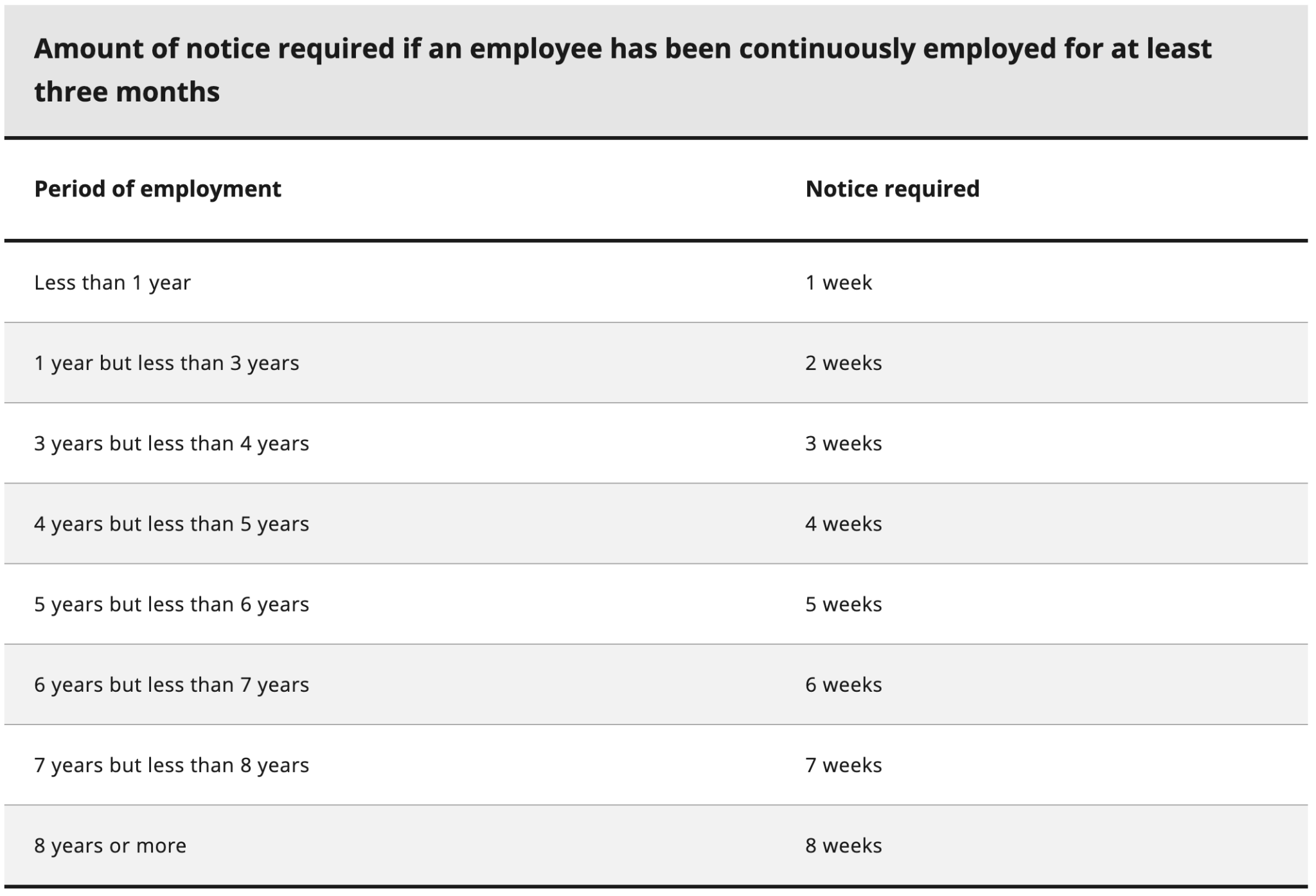
EXAMPLE: Minimum notice provided in the Ontario Employment Standards Act
Legally, employment contracts cannot provide notice less than these entitlements. If a journalist is fired and doesn’t receive them, they can pursue the minimum amounts by filing an employment standards claim. Claiming statutory minimums as an employee is a free process that uses the mechanisms created by the provincial or federal government.
Deadlines, filing procedures, and available remedies vary by jurisdiction. In some cases, pursuing an employment standards complaint may affect the ability to later pursue a civil claim. Workers should confirm the applicable framework before filing.
THE COMMON LAW
Those statutory minimums aren’t necessarily all a worker who loses their job may get, Langille adds. While provincial or federal employment standards legislation typically limits the amount of notice or pay in lieu to a certain number of weeks, employees may be entitled to more under either common law — for employees under federal jurisdiction and in every province but Quebec — or under Quebec’s Civil Code.
In both cases, employers must give reasonable notice or pay in lieu, which may be more than the relevant provincial or federal employment standards legislation. Depending on the circumstances, reasonable notice can significantly exceed statutory minimums and, in exceptional cases, may approach 24 months. A four-year employee, for example, might be entitled to as much as five and a half months, Langille notes.
For common law, the leading case which courts use to make that assessment involves a media worker. The 1960 case, called Bardal v Globe & Mail Ltd., lists factors which courts look to when they determine how much notice an employee is entitled to when they are fired without cause. The factors include the employee’s age, length of service, character of employment, and availability of similar employment. In Quebec, courts consider similar factors.
“Anytime you switch jobs or get terminated, I’d suggest having the contract reviewed by an employment lawyer, especially at the point of termination,” says Langille.
Key points about compensation after a job loss:
- Your contract and collective agreement (if you have one) should outline what compensation you can receive.
- Minimum standards are also laid out in the relevant employment standards legislation (provincial or federal, depending on your workplace).
- If you’re offered less than those minimums, you can file an employment standards claim with the provincial or federal government.
- You may be entitled to more compensation, particularly if you had been employed for a significant amount of time; ask a lawyer.
Journalists who worked without a contract, or whose contract didn’t contain a clause limiting their termination pay, might be able to pursue common law pay in lieu of notice. In fact, Langille says that workers with no contract at all might be the best off, because nothing is explicitly limiting their ability to pursue a remedy.
Moreover, Langille says that even if the employment contract does contain a term that limits the amount of termination pay, the term may be invalid. Many contracts might offer some amount of pay that is larger than the minimum — but it still might not hold up in court. “Underpinning that is the move to exclude an employee from being able to get their common law notice, which is inevitably going to be far richer than what the Employment Standards Act provides.” This is why he recommends speaking with a lawyer.
In many cases, he explains, these contracts aim to limit employees from accessing common law pay in lieu of notice. He notes that in Ontario, courts have repeatedly struck down these types of contracts.
MISCLASSIFICATION
There are other considerations when it comes to the increasing number of journalists who are freelancers, or on precarious contracts where they aren’t considered employees.
Sarah sees how journalists might be uniquely vulnerable to precarity or under-compensated work, because many start out as unpaid interns. “When you’re in an unpaid internship, there’s already a power dynamic that gets reinforced, and then I think you internalize that as your worth,” she says. If journalists are used to making significant contributions to a newsroom for free, Sarah says that they start to feel like “your work is worth nothing, money-wise.”
Langille notes that many media organizations are able to function by having a “better-paid core” of employees, who might be unionized or be classed as employees, and then a larger number of people who are precariously employed or temporary workers “on the outer edges of the labour market.”
Sometimes, workers are fulfilling the role of an “employee” but are still labelled as an independent contractor or freelancer. This distinction can be the difference between receiving the legal entitlements an “employee” would be owed, ranging from minimum wage to termination pay.
Employees who are illegally “misclassified” as freelancers or contractors have legal recourse, Langille explains.
There are several avenues for claims, Langille explains. A worker can file a claim for their lost statutory entitlements like vacation pay, overtime pay, lost minimum wage, and termination pay through the federal or provincial employment standards process. They could also consult a lawyer about the viability of pursuing a wrongful dismissal claim at common law or ask the Canada Revenue Agency to consider whether their job was insurable or pensionable, which would give them access to benefits like Employment Insurance or the Canada Pension Plan.
Someone who works for a provincially regulated outlet in Ontario, for example, could file an Employment Standards claim with the Ministry of Labour — a free process — and mention that they feel they have been misclassified as an independent contractor. The Ministry would then make a determination based on the characteristics of the work and relationship with the employer, beyond just the job title.
The Supreme Court of Canada has outlined factors to consider in this determination, but has also found that there is no definitive, universal test.
In the 2001 case 671122 Ontario Ltd. v Sagaz, the Supreme Court assessed a variety of different legal tests to determine whether someone is an employee in the common law. These include:
- The control test: examining whether there is an employer who can exercise control over the employee
- The four-fold test: assesses four elements, including control, ownership of tools, chance of profit, and risk of loss
- The organization test: examining how integral the worker is to the structure of the organization
In the context of employment standards claims, another relevant test is the “statutory purpose test,” which comes from the 1977 Majestic Maintenance Services Limited case. That test looks beyond characteristics of the work like ownership of tools or supervision of work; it considers the broader economic relationship involved in the job, and whether the employee is economically dependent on their employer and therefore ought to be covered by the protections of employment legislation.
That said, Langille notes, the same overall power imbalance which makes workers take precarious jobs can also deter them from exercising their legal rights.
In practice, courts and tribunals examine factors such as control over the work, financial risk, integration into the business, and whether the worker operates an independent enterprise.
For workers who are potentially misclassified, and for employees in general, Langille says the question is what they hope to gain. “Fighting a large employer at the outset of your career can be very career-limiting,” he says.
The complexity of a misclassification claim means that for someone hoping to remain in the industry, they may want to assess the amount they might receive against the potential drawbacks.
“It’s a bit of a cautionary tale because often there’s a severe power imbalance, particularly with the journalists who are precariously employed, especially living in high cost-of-living cities,” he says.
Key points about misclassification:
- Often, media workers are misclassified as freelance and contract workers when they are effectively employees.
- This can prevent those workers from being eligible for things like vacation pay, EI and CPP.
- To determine if this is the case, courts look at many factors, including the worker-employer relationship and the nature of the work.
- Misclassified workers have legal recourse through the provincial or federal employment standards process.
RESOURCES
The resources below provide general information and complaint processes. However, employment rights can depend on specific facts, strict deadlines and the applicable jurisdiction. In some situations, filing a complaint with one body may affect your ability to pursue other legal options.
If you are unsure which regime applies to you, are facing termination, or believe you have experienced discrimination or misclassification, you may wish to seek independent legal advice before taking formal steps.
Federal (Canada Labour Code Workplaces)
Applies to federally regulated sectors, including most broadcasting, telecommunications and interprovincial transportation employers.
- Labour Program (Employment Standards – Canada Labour Code)
- Federal Workplace Health and Safety
- Canadian Human Rights Commission
- Employment Insurance (EI)
- Canada Pension Plan (CPP)
Ontario
British Columbia
Alberta
Quebec
- CNESST (Labour Standards and Workplace Safety)
- Tribunal administratif du travail (TAT)
- Commission des droits de la personne et des droits de la jeunesse
Manitoba
Saskatchewan
- Saskatchewan Employment Standards
- Workers’ Compensation Board – Saskatchewan
- Saskatchewan Human Rights Commission
Nova Scotia
- Labour Standards Division
- Workers’ Compensation Board of Nova Scotia
- Nova Scotia Human Rights Commission
New Brunswick
Newfoundland and Labrador
Prince Edward Island
Yukon
Northwest Territories & Nunavut
- Employment Standards (NWT & Nunavut)
- Workers’ Safety and Compensation Commission (WSCC)
- Human Rights (NWT)
- Human Rights Tribunal of Nunavut
Additional reporting by Riley Sparks